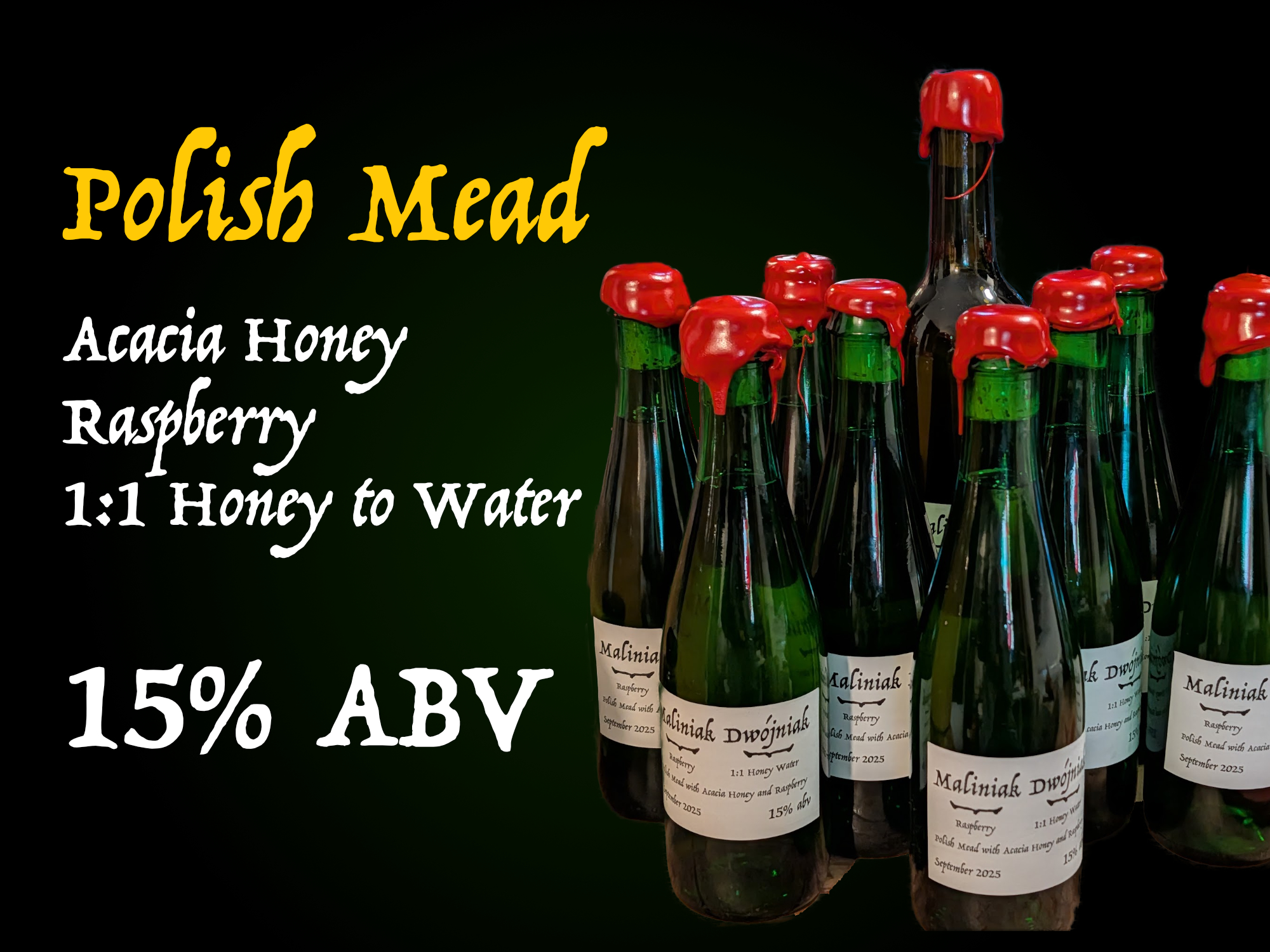
Poland has a long history of mead making, possibly the best when it comes to a near-unbroken history of producing it from long ago into the modern day, whereas many other European countries largely forgot mead in favour of wine, beer and spirits.
The style often uses ratios of honey to water; from czwórniak - one part honey to three parts water, all the way to półtorak - which is a ludicrious two parts honey to one part water. The former being a fairly standard and easier-to-ferment beverage, while the latter is one that some makers suggest takes decades to go from production to the drinking stage.
I decided to attempt making a Dwójniak, but also slightly crossing the lines here by using raspberries, making it a Maliniak style, according to sources that I made up.
The reason for this was mostly practicality - even with strong nutrient additions, such a high honey to water ratio is a tough fermentation to complete. Any time I've used fruit, however, I have a much easier time with fermentation speed as well as completion, compared to traditionals with just honey.
Here's what I used:
- 1800g Polish Multifloral Honey
- 680g Acacia Honey
- 150g Raspberries
- 5g EC1118 Yeast
- 5g GoFerm
- 3g DAP
- 5g Fermaid O
I picked EC-1118 yeast - a bit of a basic choice, but it's been chosen for it's high-abv cap, fairly neutral profile, and resilience in high sugar environments. For the best start possible, I prepared it with GoFerm to the instructions to ready it for the high gravity environment I'm pitching to. Given the near one-to-one ratio of honey and water in this recipe, which started at a gravity of 1.152, this would be a challenging fermentation with chances of stalls and off flavours.
The nutrients were broken down into 6 additions, weighing more on DAP at the start and then Fermaid O on the last two additions, as DAP is not useful past a certain ABV in fermentation.
Starting on the 15th September 2025 at 1.152 - and measuring at 1.042 on the 16th October 2025, this was approximately 14.9% alcohol after one month, with fermentation seemingly halting naturally at this point.
Unfortunately, I didn't hit the theoretical ABV limit/expectation that my yeast could reach. 1.152 is a high-stress environment to start in, which is already stressful to start - nevermind the alcohol level towards the end. Here's some things I could have done better:
- Creating a yeast starter to build up a larger colony of yeast cells, which may have been a less stressful start as the yeast could get to work faster on conversion rather than increasing numbers in a high stress environment. This would also help with a cleaner fermentation flavour.
- Step feeding sugars, starting at about 1.100 and adding more sugars progressively as the yeast converts them. This helps reduce stress for better flavour and health, and possibly could have increased the natural halting point to finish stronger.
Now to wait.
The hardest part with this is giving it time. As of writing this in early March, it's only really had a fraction of the time this style would typicall call for.
Right now, there is a hot alcohol scent coming out that isn't too offputting, but it does give it a slight off note. Looking past this though, there is a brilliantly strong floral honey smell - I think with time to rest, this would settle into something quite lovely, but it needs time to mellow out.
Wax Dipping
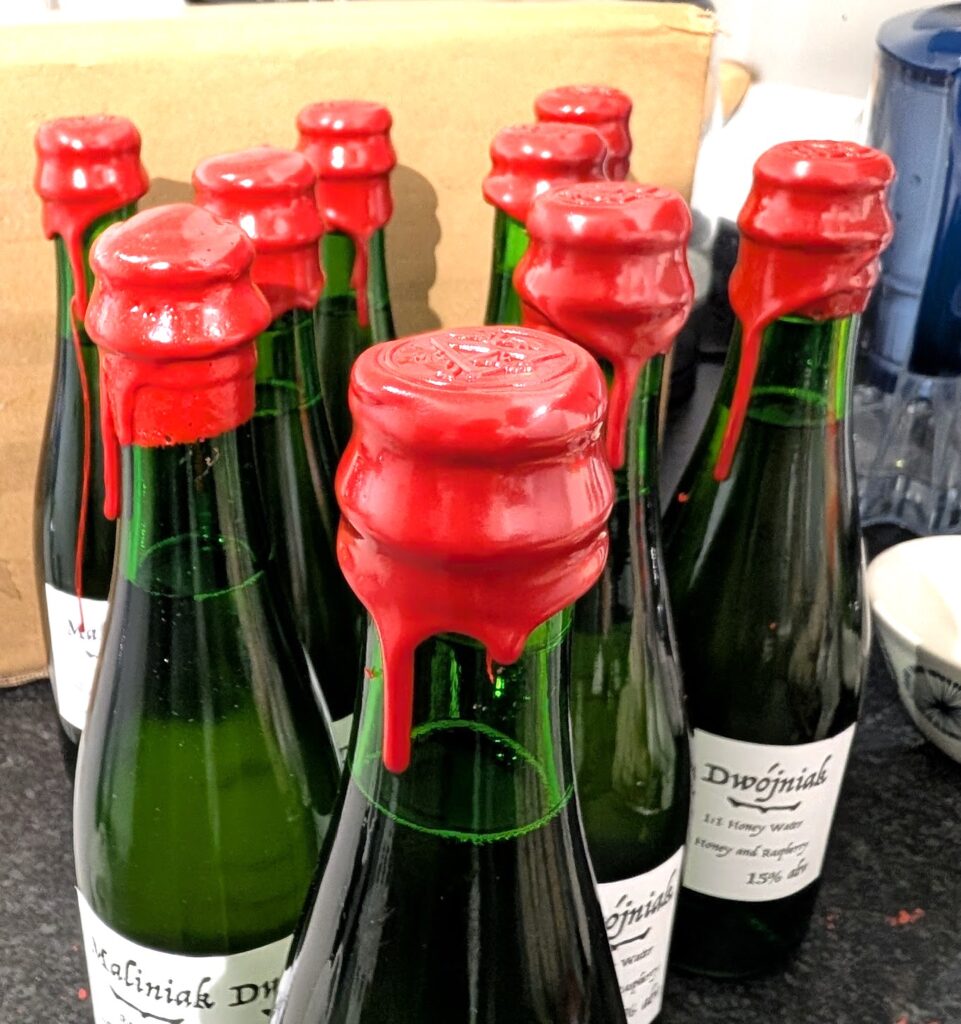
I bottled most of this batch in 375ml corked bottles, and dipped them in wax. This was my first attempt doing wax dipping and I do think it would benefit to have a proper wax melting pot. My first attempt had the wax far too thick when I tried it on a stove top using a pot of boiling water below, as some guides online said to try. However, perhaps it was the wrong type of wax, as this did not work.
I tried again putting a pot of the wax in the oven and getting up to about 140c instead of 100c as the steam method would have yielded, which seemed much better. That being said, I think this method needs some work still, as this wax was very brittle. I'd like a softer and more elastic finish next time, so I'll have to explore this more.
xrxdjththerkvowkxnmxintzkyyxnd
If you are mad at me, just curse me out